

Comparisons that need better coverage: where AI answers compare providers and your company is missing, misdescribed, or framed by someone else's narrative.
/ AI Competitor Intelligence
Understand where competitors win consideration and what to investigate next.
Measure competitor performance within agreed buyer situations, identify the sources that shape those answers, and turn the difference into a prioritized investigation plan.
Scope, questions, platforms, and price are agreed before work starts. We review every request manually and respond within one business day.
/ What it informs
Briefings built around decisions your team needs to make.
Use this service when a planning, positioning, or content decision would benefit from current evidence about AI answers in your category.
Evidence input
Current AI answer evidence
Cited sources that deserve research: which publications and pages the answers reference, and whether your company appears in them.
Which website and evidence work to prioritize: the gaps most likely to matter, sequenced for your team's capacity.
/ Why now
Bring current evidence into the next planning decision.
AI answers shift as models, sources, and competitor content change. A dated, scoped briefing turns a general concern about visibility into specific observations your team can discuss and act on.
/ Deliverables
What you receive.
Every briefing is built from an agreed question set and platform scope, with the evidence behind each observation.
Dated question and platform records
The questions tested, platforms used, collection dates, scoring rules, counts, and denominators. Model versions are recorded where available.
Competitor and source map
Which companies the answers put forward for each question, and the exact URLs observed as sources.
Executive brief
A short document written for decision-makers: what the observations suggest, what they do not establish, and where uncertainty remains.
Prioritized investigation plan
Possible explanations to investigate, with a proposed check for each and a suggested order of work.
Supporting analytical view
Illustrative onlyCompetitor visibility matrix
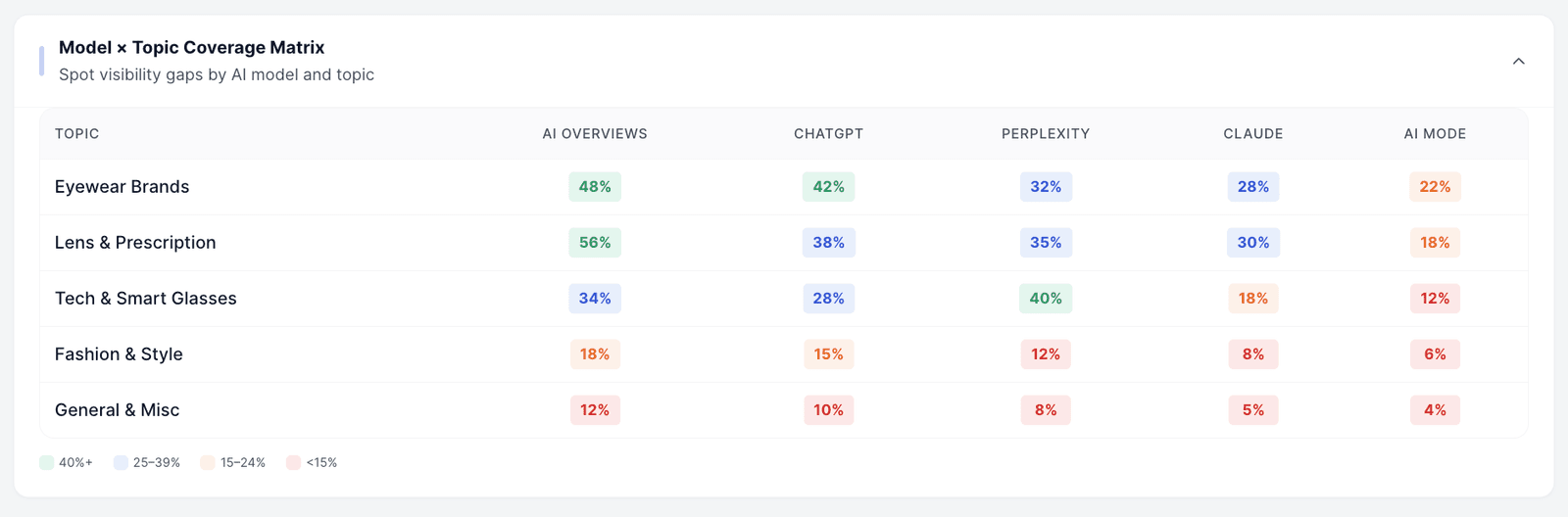
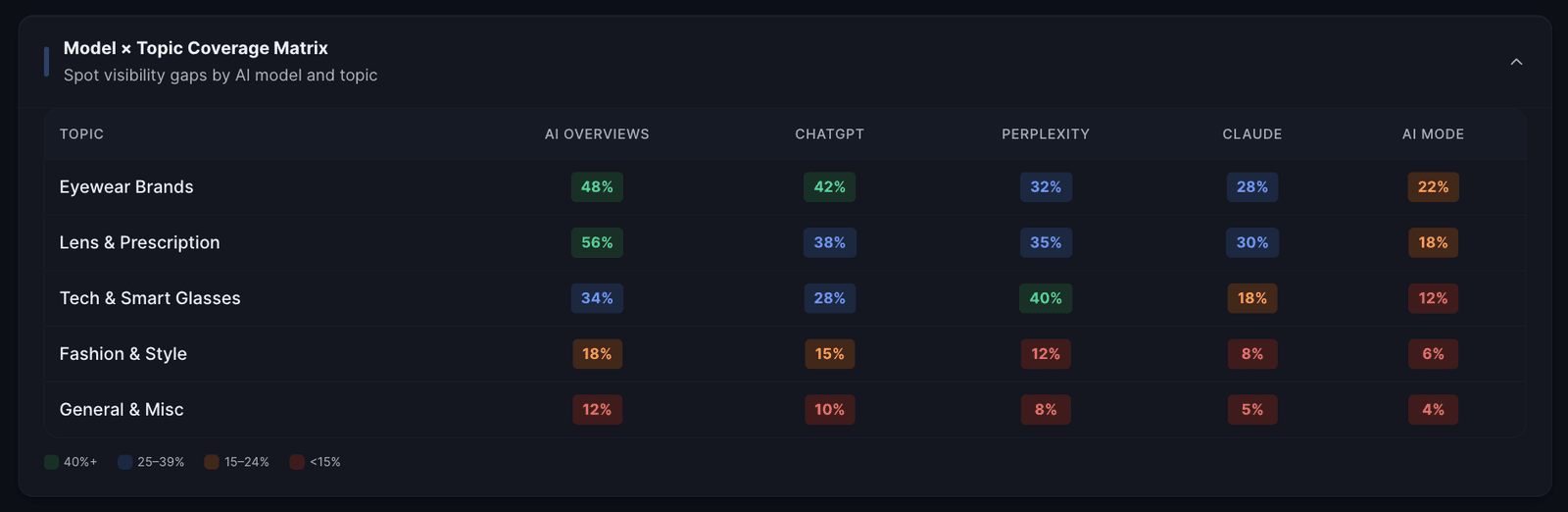
/ Illustrative example
What a briefing excerpt looks like.
Illustrative briefing, not measured market or client data. A real brief uses your agreed scope and records every observation with its source.
Illustrative analyst worksheet
Briefing excerpt
Illustrative briefing, not measured market or client data.
- 01Research question
How are providers in the category compared when buyers ask about onboarding support?
- 02Scope to agree
Markets, your company, the competitor set, the prompt set, platform versions, collection dates, and repeat runs.
- 03Example observation
Fictional: one sampled answer mentions onboarding support but cites no implementation detail for any provider.
Fictional observation
- 04Hypothesis
The decision-stage pages may lack a clear onboarding explainer. This is a hypothesis and requires validation.
Requires validation
- 05Proposed check
Review your own service pages alongside the referenced sources to confirm whether the gap exists.
- 06Next decision
If the gap is confirmed, approve an expert interview to develop the missing explanation.
/ Public and commissioned
How this relates to our public research.
Public reports and commissioned briefs answer different questions and carry different scopes and rights.
PublicCommissioned Ongoing
Public category research
Published reports interpret a defined benchmark scope for a whole category. They are written for general readers and shared openly.
Explore this scopeCommissioned brief
Starts from your question and your company. The scope, outputs, and confidentiality are agreed with you, and the deliverables are private.
Ongoing visibility tracking
Repeats an agreed measurement framework on a set cadence so movement can be compared across runs. This is a separate, continuing scope.
Explore this scope/ Process
How a briefing engagement runs.
- Briefing stage 01
Align on decisions: we agree your priorities, the competitor set, the buyer questions, and the platforms before any testing begins.
- Briefing stage 02
Collect and review: we run the defined sample, record each answer with its sources, and check the facts behind what we report.
- Briefing stage 03
Discuss priorities: we walk your team through the findings, you confirm the facts about your company, and we agree what to investigate or fix first.
/ Why now
Create the baseline while the answer is still changing.
AI models and answer systems are still changing what they retrieve and recommend. That creates an opening: you can improve the evidence they find before incomplete or inconsistent answers become familiar to buyers. Start with a benchmark now, then measure what changes.
/ Pricing & scope
Configure this scope around your priorities.
Adjust the quantities to create a planning estimate. You can use a service on its own or combine it with the full five-step system. We review every configuration before work begins.
Monthly · $100 per cluster per month · minimum 10
1 cluster = 10 related buyer-intent prompts. The controlled starting benchmark is 10 clusters / 100 prompts across 6-7 agreed LLMs.
Controlled baseline.
$1,000
10 buyer-intent clusters
- Controlled baseline:
- 10 buyer-intent clusters
- Derived prompts:
- 100 prompts
- Approximate prompt-platform runs per wave:
- 600–700
A scoping input, not a billable unit. There is no competitor surcharge.
Estimate summary
- 10 buyer-intent clusters
- $1,000
- Estimated monthly total
- $1,000
- Estimated one-time total
- $0
- Estimated approved pass-through
- $0
- Estimated first month
- $1,000
Estimated first month $1,000. Estimated monthly total $1,000.
Planning estimate only. Final scope, cadence, dependencies, third-party costs, and commercial terms are confirmed in a written statement of work. AI rankings, citations, traffic, revenue, and editorial outcomes are not guaranteed.
Measurement describes a defined sample of prompts, platforms, and locations on the dates observed, and results vary between runs. Client factual approval is required before anything is published, and publishers and platforms keep editorial and ranking control.
We review the configuration for dependencies, sequencing, feasibility, and third-party costs before proposing a final scope.
/ System fit
Use this service on its own or connect it to the five-step system.
A focused scope works when the question is already clear. The connected system works best when measurement points to website, evidence, technical, and publishing gaps that need to move together.
/ FAQ
Common questions.
Which AI platforms do you test?
We agree the platform set with you based on where your buyers are likely to ask. The brief documents the test dates and the model or platform versions where that information is available.
Are the results representative of the whole market?
A briefing reports a defined sample of questions, not a statistical population unless a statistical basis has been explicitly agreed and documented. Every figure is dated, scoped, and reported with its denominator.
Why would we repeat the measurement?
AI answers vary by model, prompt, session, location, personalization, and date. Repeating the same framework on an agreed cadence shows whether positions are moving; a single run shows where you stood on those dates.
Does the plan include implementation?
No. The briefing ends in a prioritized investigation plan. Implementation is a separate, agreed scope. See GEO Services. No briefing can guarantee a change in how AI platforms answer.
/ Next step
Give the next strategy discussion a stronger starting point.
Share the questions and competitors you want examined. We agree the scope and price before work starts. Every request is reviewed manually by our team.