

Wildes & Weinberg AI Visibility Market Strategy Report - Immigration Law Firms
Answer Capsule
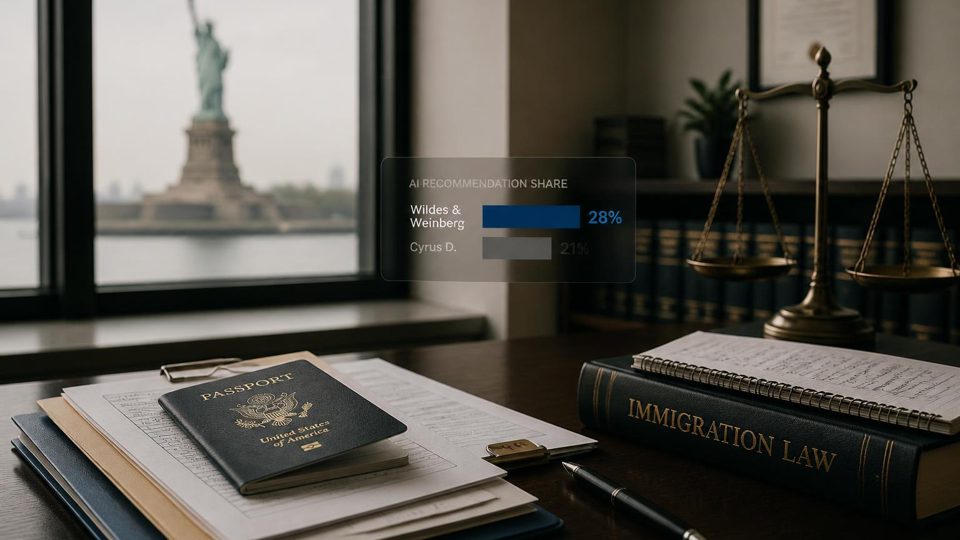
Wildes & Weinberg is the dominant recommendation leader in the Immigration Law Firms AI Market Discovery Index for October 2026, holding 86.96% valid recommendation coverage across 46 qualified observations. The firm is recommended in nearly nine of every ten qualified AI responses, a 65.3-point lead over the next closest firm, Cyrus D. Mehta & Partners at 21.74%. The clearest win is sustained category leadership with a perfect net sentiment score of 1.00. The clearest weakness is placement quality: top-three recommendation rate fell from 72.9% in July 2026 to 50.00% in October 2026, and rank-one rate fell from 38.6% to 17.39% over the same period. The clearest opportunity is converting broad presence into stronger first-position recommendation share, particularly on platforms where the firm is visible but not ranked first.
Who This Report Is For
This report is for immigration law firm leadership, marketing strategists, and business development teams evaluating how AI systems recommend legal service providers in the immigration category. It is also relevant for firms seeking to understand competitive positioning in AI-led discovery.
Report Card
Field | Value |
|---|---|
Report type | AI Visibility Company Market Strategy Report |
Target company | Wildes & Weinberg |
Category / market studied | Immigration Law Firms |
Reporting month | October 2026 |
AI platforms tracked | 5 (ChatGPT, Copilot, Gemini, AI Overviews, AI Mode) |
Public high-intent clusters | 1 |
AI observations analyzed | 46 |
Competitors tracked | 5 |
Executive Summary
Wildes & Weinberg holds dominant recommendation power in the Immigration Law Firms category for October 2026. The firm recorded 86.96% valid recommendation coverage across 46 qualified observations, meaning it received a valid, attributable recommendation in nearly nine of every ten AI responses collected. This represents a 65.3-point lead over the next closest firm, Cyrus D. Mehta & Partners, which reached 21.74% coverage in the same period.
The firm's mention profile is entirely positive. Of 40 mentions recorded in October 2026, all 40 were classified as positive, producing a net sentiment score of 1.00. No negative or neutral mentions were recorded. This indicates that when AI systems surface Wildes & Weinberg, they do so with favorable framing.
The strongest cluster for Wildes & Weinberg is C01, Best Immigration Law Firm Discovery, which is the only cluster with sufficient observation coverage in the current benchmark. Within this cluster, the firm recorded 50.00% top-three rate and 17.39% rank-one rate. The firm's average recommended rank when it receives rank credit is 3.23.
The clearest platform signal comes from Google AI Overviews, where Wildes & Weinberg recorded 92.3% valid recommendation coverage across 26 observations. The firm also performed strongly on ChatGPT with 66.7% coverage and on Google AI Mode with 77.8% coverage. On Copilot, the firm recorded 100% coverage but with an average recommended rank of 6, indicating presence without top-position strength.
The clearest gap is placement quality. While the firm's coverage remained stable from July 2026 to October 2026, its top-three rate fell from 72.9% to 50.00%, a decline of 22.9 points. Its rank-one rate fell from 38.6% to 17.39%, a decline of 21.2 points. The firm is still recommended in the great majority of qualified observations, but a materially smaller share of those appearances now land in the top three or at first position.
The benchmark's citation layer shows that wildeslaw.com was cited 32 times across four platforms, ranking second among all cited domains. This indicates the firm's owned content is part of the public evidence layer that AI systems retrieve and synthesize.
What Wildes & Weinberg Is Winning
Questions This Section Answers
- How large is Wildes & Weinberg's recommendation lead over the next closest immigration firm?
- Which platform produces the firm's strongest recommendation signal?
- How widely is wildeslaw.com cited across AI platforms?
Wildes & Weinberg holds the strongest recommendation position in the Immigration Law Firms category by a wide margin. The firm's 86.96% valid recommendation coverage is 65.3 points above the next closest competitor, Cyrus D. Mehta & Partners at 21.74%. This is not a narrow lead; it is category dominance on the benchmark's primary measure of standing.
The firm's sentiment profile is flawless. All 40 mentions recorded in October 2026 were positive, producing a net sentiment score of 1.00. No negative or neutral framing was detected. When AI systems recommend Wildes & Weinberg, they do so with consistently favorable language.
Google AI Overviews is the firm's strongest platform. Across 26 observations on this platform, Wildes & Weinberg recorded 92.3% valid recommendation coverage, 53.8% top-three rate, and 19.2% rank-one rate. The firm's average recommended rank on this platform is 3.17. This is the platform where the firm captures the largest share of available recommendation opportunity.
The firm's owned domain, wildeslaw.com, is the second most-cited domain in the benchmark's citation layer, appearing 32 times across Copilot, Gemini, AI Mode, and AI Overviews. This indicates that the firm's public content is highly retrievable and appears to be part of the source footprint AI systems draw from when forming recommendations.
Where Wildes & Weinberg Has the Clearest AI Visibility Gaps
Questions This Section Answers
- Why is placement quality, rather than presence, the firm's clearest gap?
- How much did Wildes & Weinberg's top-three and rank-one rates decline between July and October 2026?
- What does the firm's average recommended rank of 3.23 suggest compared with Cyrus D. Mehta & Partners?
The clearest gap for Wildes & Weinberg is placement quality, not presence. The firm is recommended in 86.96% of qualified observations, but it appears in the top three in only 50.00% of those observations and at first position in only 17.39%. This means that in roughly half of the responses where the firm is recommended, it is not among the top three options presented.
The decline in placement quality is significant. In July 2026, the firm's top-three rate was 72.9% and its rank-one rate was 38.6%. By October 2026, those figures had fallen to 50.00% and 17.39% respectively. The firm lost 22.9 points of top-three placement and 21.2 points of rank-one placement over the four-month series. Coverage held steady, but the strength of each recommendation weakened.
On Copilot, the firm recorded 100% valid recommendation coverage across 2 observations, but its average recommended rank was 6. This indicates that the firm is present in Copilot responses but is not positioned near the top of the recommendation list. The firm is visible but not recommended as a leading option on this platform.
The firm's average recommended rank across all platforms is 3.23. While this is a strong average, it indicates that the firm is more often recommended in the third position than the first. Cyrus D. Mehta & Partners, the second-ranked firm, has an average recommended rank of 2.60, meaning that when it is recommended, it tends to appear higher in the list than Wildes & Weinberg.
The benchmark does not contain qualified observations in the Pricing & Value or Multi-Brand Comparison clusters. This means the benchmark cannot yet show how AI systems position Wildes & Weinberg on cost, fee structure, or head-to-head comparisons. These are gaps in the benchmark's coverage, not necessarily gaps in the firm's visibility.
Biggest Opportunity
Questions This Section Answers
- What is Wildes & Weinberg's clearest path to converting its dominant presence into first-position recommendations?
- Which prompt cluster and platforms offer the strongest first-position opportunity for the firm?
The biggest opportunity for Wildes & Weinberg is to convert its dominant presence into stronger first-position recommendation share. The firm is already recommended in nearly nine of ten qualified observations, but it appears at rank one in only 17.39% of those observations. Moving from presence to first-position preference is the clearest path to strengthening its recommendation position.
This opportunity is concentrated in the Best Immigration Law Firm Discovery cluster, which is the only cluster with sufficient observation coverage in the current benchmark. The prompts in this cluster ask AI systems to name or recommend a specific immigration law firm, such as "Who is the best immigration lawyer in NYC?" and "best immigration lawyer nyc free consultation." These are high-intent prompts where the buyer is directly asking for a recommendation.
The firm's strongest platform, Google AI Overviews, already shows 19.2% rank-one rate. ChatGPT shows 33.3% rank-one rate across 3 observations. These are the platforms where the firm has the strongest first-position signal. The opportunity is to extend that first-position strength to other platforms and to a larger share of responses within each platform.
Competitive Landscape
Questions This Section Answers
- How does Wildes & Weinberg's top-three and rank-one rate compare with other tracked immigration firms?
- Which competitor is the strongest challenger to Wildes & Weinberg's recommendation lead?
- Why does a smaller competitor like Bretz & Coven show a better average recommended rank than Wildes & Weinberg?
Wildes & Weinberg holds dominant recommendation-stage strength in the Immigration Law Firms category, with a 65.3-point lead over the next closest firm. Cyrus D. Mehta & Partners is the strongest challenger, having risen from 2.9% coverage in July 2026 to 21.74% in October 2026. The remaining tracked firms hold minimal recommendation coverage.
Brand | Top-3 rate | Rank-1 rate | Avg recommended rank | Sentiment |
|---|---|---|---|---|
Wildes & Weinberg | 50.00% | 17.39% | 3.23 | 1.0000 |
Cyrus D. Mehta & Partners | 15.22% | 4.35% | 2.60 | 1.0000 |
Bretz & Coven | 4.35% | 2.17% | 1.50 | 1.0000 |
Spar & Bernstein | 2.17% | 2.17% | 3.00 | 0.6667 |
Barst & Mukamal | 0.00% | 0.00% | N/A | 0.0000 |
Transparent Justice Law Firm | 0.00% | 0.00% | N/A | 0.0000 |
Average recommended rank covers rank-eligible recommendations only.
Wildes & Weinberg leads the category on top-three rate and rank-one rate by substantial margins. The firm's top-three rate of 50.00% is more than three times the next closest firm's rate. Its rank-one rate of 17.39% is four times the next closest firm's rate. However, the firm's average recommended rank of 3.23 is higher than Cyrus D. Mehta & Partners at 2.60 and Bretz & Coven at 1.50, indicating that when the firm is recommended, it tends to appear lower in the list than some competitors with smaller coverage.
Prompt Evidence
Google AI Overviews / Best Immigration Law Firm Discovery Prompt: "Who is the best immigration lawyer in NYC?" Result: Wildes & Weinberg was recommended at rank one, contributing to the firm's 19.2% rank-one rate on this platform.
ChatGPT / Best Immigration Law Firm Discovery Prompt: "best immigration lawyer new york" Result: Wildes & Weinberg was recommended at rank one, contributing to the firm's 33.3% rank-one rate on ChatGPT across 3 observations.
Copilot / Best Immigration Law Firm Discovery Prompt: "immigration lawyer in new york city" Result: Wildes & Weinberg was present and recommended, but at an average rank of 6, indicating visibility without top-position strength on this platform.
Google AI Mode / Best Immigration Law Firm Discovery Prompt: "best immigration lawyer nyc free consultation" Result: Wildes & Weinberg was recommended among the top three options, contributing to the firm's 55.6% top-three rate on this platform.
What CiteWorks Studio Would Do Next
Phase 1: AI Market Discovery Audit Map the firm's current recommendation footprint across all tracked platforms and identify which specific prompts and surfaces produce top-three and rank-one placements versus lower-position recommendations.
Phase 2: Recommendation Readiness Plan Prioritize the prompts and platforms where the firm is visible but not ranked first, focusing on the gap between 86.96% coverage and 17.39% rank-one rate.
Phase 3: Owned Answer Layer Buildout Strengthen the firm's owned content on wildeslaw.com to reinforce the attributes AI systems associate with top-position recommendations, building on the domain's existing citation strength.
Phase 4: Citation / Authority Layer Development Expand the firm's presence in the legal directory, bar association, and third-party source layer that AI systems cite when forming recommendations in this vertical.
Phase 5: Monthly AI Visibility and Recommendation Tracking Track coverage, top-three rate, rank-one rate, and sentiment month over month to measure whether placement quality improves and to detect competitive shifts early.
Why This Matters
AI presence alone is not enough. Wildes & Weinberg is recommended in 86.96% of qualified observations, but it appears at rank one in only 17.39% of those observations. A buyer asking an AI system for the best immigration lawyer in New York may see the firm recommended, but not as the first or strongest option. The difference between being on the shortlist and being the top recommendation is the difference between consideration and selection.
The next move is targeted correction of the prompt, page, and citation layers. The firm's owned domain is already highly cited, and its sentiment profile is flawless. The opportunity is to strengthen the attributes and evidence that AI systems associate with first-position recommendations, particularly on platforms like Copilot where the firm is present but ranked lower. This is not about increasing visibility; it is about increasing recommendation strength at the decision moment.
Core Metrics
Metric | Value |
|---|---|
Mentions | 40 |
Valid recommendations | 40 |
Top 3 recommendation count | 23 |
Rank #1 recommendation count | 8 |
Average recommended rank | 3.23 |
Positive mentions | 40 |
Neutral mentions | 0 |
Negative mentions | 0 |
Raw mention presence rate | 86.96% |
Valid recommendation coverage | 86.96% |
Top 3 recommendation rate | 50.00% |
Rank #1 recommendation rate | 17.39% |
Net sentiment score | 1.00 |
Strongest cluster by recommendation behavior | C01: Best Immigration Law Firm Discovery |
Strongest platform by recommendation behavior | Google AI Overviews |
Sentiment Score
Questions This Section Answers
- What does Wildes & Weinberg's sentiment score of 1.00 tell us about how AI systems frame the firm?
- Why can a firm have perfect sentiment and still be recommended at a lower position than a competitor?
Sentiment Score = (positive mentions × 1 + neutral mentions × 0 + negative mentions × -1) / total mentions
For Wildes & Weinberg in October 2026: (40 × 1 + 0 × 0 + 0 × -1) / 40 = 1.00
This score matters because unclassified mention counts are misleading. A positive recommendation, a neutral reference, a cautionary mention, and a competitor-displaced mention are not equal. Counting all mentions as wins is bad measurement. Classified sentiment is required before interpreting AI visibility.
Wildes & Weinberg's sentiment score of 1.00 indicates that every mention recorded in October 2026 was positive. No neutral or negative framing was detected. This is the strongest possible sentiment profile. However, sentiment score measures framing quality, not recommendation strength. A firm can have perfect sentiment and still be recommended at a lower position than a competitor with a lower sentiment score.
Sentiment by Platform
Questions This Section Answers
- Which AI platform produces the strongest public recommendation signal for Wildes & Weinberg?
- On which platform is the firm present but not recommended at a top position?
Platform | Mentions | Positive | Neutral | Negative | Sentiment Score | Readout |
|---|---|---|---|---|---|---|
Google AI Overviews | 24 | 24 | 0 | 0 | 1.00 | Strongest public recommendation signal |
Google AI Mode | 7 | 7 | 0 | 0 | 1.00 | Strong recommendation presence |
Gemini | 5 | 5 | 0 | 0 | 1.00 | Positive, but sample smaller than AI Overviews |
ChatGPT | 2 | 2 | 0 | 0 | 1.00 | Positive, but sample too small |
Copilot | 2 | 2 | 0 | 0 | 1.00 | Present, but not recommendation-led at top position |
Methodology
- This report is a benchmark-based analysis of AI recommendation visibility for Wildes & Weinberg in the Immigration Law Firms category. It is not a client implementation case study.
- The reporting month is October 2026. The benchmark series covers July 2026 through October 2026.
- The AI platforms tracked in this benchmark are ChatGPT, Copilot, Gemini, AI Overviews, and AI Mode. Perplexity was not captured in the October 2026 qualified observation set.
- The October 2026 benchmark analyzed 46 qualified observations. These observations survived both the relevance and qualification stages.
- The competitor universe consists of six tracked brands: Wildes & Weinberg, Cyrus D. Mehta & Partners, Bretz & Coven, Spar & Bernstein, Barst & Mukamal, and Transparent Justice Law Firm.
- The public benchmark contains one high-intent cluster with sufficient observation coverage: C01, Best Immigration Law Firm Discovery. The Pricing & Value and Multi-Brand Comparison clusters registered zero qualified observations in October 2026.
- Stage 0 refers to the initial prompt-surface observation collection. In October 2026, the collection began with 53 prompt-surface observations and 50 unique questions. After qualification, 46 observations remained.
- A mention is defined as any appearance of the brand in an AI response, regardless of whether the brand is recommended. A valid recommendation is defined as a response where the brand receives a valid, attributable recommendation.
- Brand-level percentages use the qualified observation set (46 in October 2026) as the denominator, not the raw collection. This isolates recommendation behavior from collection volume.
- With 46 qualified observations, a single valid recommendation equals approximately 2.2 percentage points of coverage. Several brand-level movements described in this report reflect changes of one or two recommendations and should be read at that scale.
- Source presence in the citation layer is evidence about the information environment. It is not automatically proof that the source caused the recommendation.
- The benchmark does not measure market share, revenue attribution, organic-search ranking positions, social mention volume, private or sponsored channels, or causality from a metric movement alone.
See How AI Is Recommending Your Brand
The public benchmark shows where Wildes & Weinberg stands in AI recommendations across the Immigration Law Firms category. A company-level AI visibility audit can show which specific prompts the firm wins, which competitors take the recommendation when the firm is displaced, what attributes AI systems associate with each option, and which external sources shape those answers. This turns the benchmark's directional signals into a concrete plan for defending and strengthening the firm's recommendation position.