

Rayne Nutrition AI Visibility Market Strategy Report - Veterinary Pet Food and Prescription Pet Nutrition
Answer Capsule
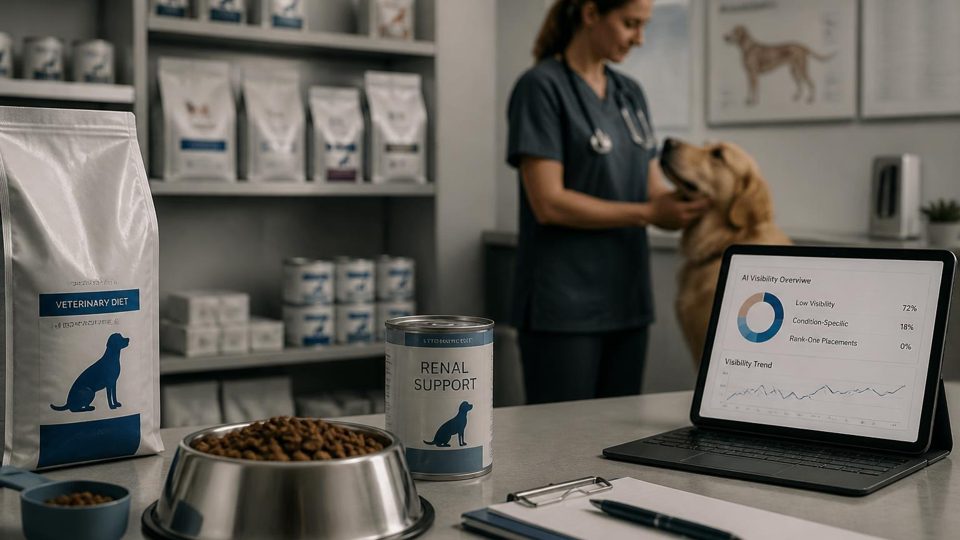
Rayne Nutrition holds almost no recommendation-stage visibility in the October 2026 veterinary pet food and prescription pet nutrition benchmark. The brand appeared in 12 of 721 qualified observations, a raw mention presence rate of 1.66%, and received valid recommendation credit in 11 of them, a coverage rate of 1.53%. It converted that presence into a top-three placement only once and never reached the first recommendation position. The clearest opportunity is not broader awareness but a narrow, condition-specific recommendation pocket where the brand can move from a passing reference to a named shortlist option.
Who This Report Is For
This report is written for Rayne Nutrition leadership, veterinary channel strategists, and brand teams responsible for how the company is discovered and recommended when pet owners and veterinary professionals ask AI systems for a therapeutic diet.
Report Card
Field | Value |
|---|---|
Report type | AI Visibility Company Market Strategy Report |
Target company | Rayne Nutrition |
Category / market studied | Veterinary Pet Food and Prescription Pet Nutrition |
Reporting month | October 2026 |
AI platforms tracked | 6 (ChatGPT, Copilot, Gemini, Perplexity, AI Overviews, AI Mode) |
Public high-intent clusters | 1 with qualified observations (3 defined) |
AI observations analyzed | 721 qualified observations from 800 source prompts |
Competitors tracked | 6 |
Executive Summary
Rayne Nutrition is visible but under-recommended. The brand registered a raw mention presence rate of 1.66% across 721 qualified observations in October 2026, and a valid recommendation coverage rate of 1.53%. That is a presence-to-recommendation gap of 0.13 percentage points, which means the brand is mentioned at roughly the same low frequency at which it is actually recommended. There is little evidence of presence converting into stronger recommendation outcomes.
The brand recorded 12 total mentions: 11 positive and 1 neutral, with no negative mentions. Its net sentiment score of 0.9167 is strong on a very small base, and it sits in line with the lower-coverage brands in the category rather than the leaders. The absence of negative framing is a genuine positive, but it is not the same as being chosen.
Recommendation placement is the sharper problem. Rayne Nutrition recorded 1 top-three recommendation and 0 rank-one recommendations in October 2026, giving a top-three rate of 0.14% and a rank-one rate of 0.00%. Its average recommended rank of 4.3 applies only to the single rank-eligible recommendation, so it should be read as a directional signal rather than a stable position.
The strongest cluster signal comes from the brand recommendation class of discovery, the only buyer-intent class with qualified observations in the current public series. Within that class, Rayne Nutrition's coverage of 1.53% trails the category leader, Royal Canin Veterinary Diet, by roughly 93.7 percentage points.
The strongest platform signal is Gemini, where the brand recorded 2 mentions, 2 valid recommendations, and a coverage rate of 2.25%. Google AI Overviews followed with 8 mentions and a coverage rate of 4.15%. ChatGPT, Copilot, and Perplexity recorded no Rayne Nutrition presence at all in the qualified data.
The clearest gap is the combination of near-zero rank-one placement and complete absence from three of the six tracked platforms. The benchmark's own diagnostic question for the brand is which prompts still surface Rayne Nutrition at all, and what distinguishes those from the prompts where the brand has disappeared across the series.
What Rayne Nutrition Is Winning
Questions This Section Answers
- Which platforms and prompt types give Rayne Nutrition its only measurable recommendation visibility?
- What does the brand's net sentiment of 0.9167 actually demonstrate given the small mention base?
The evidence-backed wins are narrow and should be described plainly.
The brand has no negative framing. Across 12 mentions, 11 were positive and 1 neutral, producing a net sentiment score of 0.9167. In a category where cautionary or comparison-anchor mentions are common, the absence of negative framing is a real asset.
Rayne Nutrition holds a small but measurable recommendation pocket on Gemini, where it recorded a 2.25% valid recommendation coverage rate and a 2.25% positive visibility rate. Google AI Overviews produced the largest single-platform mention count at 8, with a 4.15% coverage rate. These are the two surfaces where the brand has any meaningful presence.
The brand also retains a foothold in the condition-specific prompt space. Its cluster prompt examples include questions about hyperlipidemia, colitis, struvite bladder stones, pancreatitis, hydrolyzed protein diets, and food sensitivities. These are high-intent therapeutic questions where a specialist brand can plausibly earn a named recommendation.
Beyond these points, the win column is thin. Rayne Nutrition does not lead any cluster, does not lead any platform, and holds no rank-one recommendations in the qualified benchmark.
Where Rayne Nutrition Has the Clearest AI Visibility Gaps
Questions This Section Answers
- Why is the rank-one gap against Hill's Prescription Diet the core strategic problem?
- Which platforms recorded zero Rayne Nutrition mentions, and what does that absence mean?
- Does Rayne Nutrition's declining recommendation count reflect a reach problem or a reputation problem?
The most consequential gap is recommendation conversion at the top of the answer. Rayne Nutrition recorded 1 top-three recommendation and 0 rank-one recommendations across 721 qualified observations. Hill's Prescription Diet recorded 355 rank-one recommendations and a 49.24% rank-one rate in the same period. The distance between those two positions is the core strategic problem.
The second gap is platform absence. ChatGPT, Copilot, and Perplexity recorded zero Rayne Nutrition mentions in the qualified data. ChatGPT alone carried 85 qualified observations in the platform breakdown, and the brand appeared in none of them. This is not a weak signal; it is a missing one.
The third gap is displacement. Where Rayne Nutrition does appear, the recommendation credit tends to go elsewhere. The category's three leading brands, Royal Canin Veterinary Diet, Hill's Prescription Diet, and Purina Pro Plan Veterinary Diets, all sit above 90% valid recommendation coverage. Rayne Nutrition sits at 1.53%. The benchmark recorded the brand's valid recommendations falling from 29 in July 2026 to 11 in October 2026, a decline of 2.5 percentage points in coverage and the brand's third consecutive monthly decline.
The fourth gap is the small-count sensitivity that makes the decline harder to interpret. With 11 valid recommendations in October 2026, individual prompt outcomes carry disproportionate weight. The significant classification reflects a thinning presence rather than a change in how the brand is positioned when it is mentioned. That distinction matters, because it means the problem is reach, not reputation.
Biggest Opportunity
Questions This Section Answers
- Which condition-specific therapeutic prompts offer Rayne Nutrition the most winnable path to named recommendations?
The clearest path from reference to recommendation runs through condition-specific therapeutic prompts. Rayne Nutrition already appears in the prompt space around hyperlipidemia, colitis, struvite bladder stones, pancreatitis, hydrolyzed protein diets, and food sensitivities. These are the questions where a specialist veterinary nutrition brand can earn a named recommendation rather than a passing mention.
The opportunity is to convert the brand's existing positive framing into shortlist placement on those specific conditions. Rayne Nutrition does not need to compete for broad category visibility against brands with 95% or higher coverage. It needs to become the named answer on a defined set of high-intent therapeutic questions where its specialist positioning is already relevant. That is a narrower, more winnable objective than category-wide presence, and it is the one the data supports.
Competitive Landscape
Questions This Section Answers
- How far behind the leading veterinary diet brands does Rayne Nutrition sit on top-three and rank-one rates?
- Where does Rayne Nutrition land among the seven tracked brands on recommendation placement and sentiment?
Recommendation-stage strength in this category is concentrated almost entirely among three brands. Royal Canin Veterinary Diet, Hill's Prescription Diet, and Purina Pro Plan Veterinary Diets all sit above 90% valid recommendation coverage, while Rayne Nutrition sits at 1.53% and holds no rank-one recommendations.
Brand | Top-3 rate | Rank-1 rate | Avg recommended rank | Sentiment |
|---|---|---|---|---|
Royal Canin Veterinary Diet | 88.21% | 31.48% | 1.84 | 0.9774 |
Hill's Prescription Diet | 87.10% | 49.24% | 1.59 | 0.9799 |
Purina Pro Plan Veterinary Diets | 81.28% | 10.82% | 2.59 | 0.9793 |
6.93% | 0.42% | 3.77 | 0.9526 | |
Farmina Vet Life | 1.66% | 0.00% | 3.74 | 0.9302 |
Rayne Nutrition | 0.14% | 0.00% | 4.3 | 0.9167 |
0.00% | 0.00% | 6 | 0.8 |
Average recommended rank covers rank-eligible recommendations only.
Rayne Nutrition sits sixth of seven tracked brands on top-three rate and holds no rank-one placement. Its sentiment score is the second lowest in the set, though the difference from the leaders is small and the base is thin. The table shows a brand with positive framing and almost no shortlist presence.
Prompt Evidence
Gemini / Brand Recommendation Prompt: "What is the best dry dog food for colitis?" Result: Rayne Nutrition received a valid recommendation, one of only two Gemini recommendations recorded for the brand.
Google AI Overviews / Brand Recommendation Prompt: "What dog food is good for pancreatitis?" Result: The brand appeared among the mentions, contributing to its 8 AI Overviews mentions, but did not reach a top-three placement.
ChatGPT / Brand Recommendation Prompt: "What is the #1 vet-recommended dog food?" Result: No Rayne Nutrition presence. The brand recorded zero mentions across all 85 qualified ChatGPT observations.
Perplexity / Brand Recommendation Prompt: "hydrolyzed protein dog food" Result: No Rayne Nutrition presence. The brand recorded zero mentions across all 87 qualified Perplexity observations.
What CiteWorks Studio Would Do Next
Phase 1: AI Market Discovery Audit Map every qualified prompt where Rayne Nutrition appears, every prompt where it is absent, and the exact competitor that takes the recommendation in each case.
Phase 2: Recommendation Readiness Plan Prioritize the condition-specific prompts where the brand already has positive framing and a plausible specialist claim, starting with colitis, pancreatitis, and hydrolyzed protein queries.
Phase 3: Owned Answer Layer Buildout Build clear, retrievable, condition-specific answer content on the brand's own properties so AI systems have a direct source for Rayne Nutrition's therapeutic positioning.
Phase 4: Citation / Authority Layer Development Strengthen the third-party source footprint, including veterinary information sources and retail pages, that AI systems draw on when forming recommendations in this category.
Phase 5: Monthly AI Visibility and Recommendation Tracking Track mention presence, valid recommendation coverage, top-three rate, and rank-one rate monthly across all six platforms to confirm whether the brand is converting presence into shortlist placement.
Why This Matters
Questions This Section Answers
- What does it mean that Rayne Nutrition's mention rate and recommendation rate are nearly identical?
- Which three layers explain why the brand is not entering the consideration set?
AI presence alone is not enough. Rayne Nutrition is mentioned in AI answers at roughly the same low rate at which it is recommended, which means the brand is not being displaced after consideration; it is largely not entering the consideration set at all. For a specialist veterinary nutrition brand, that is the difference between being a known option and being a recommended one.
The next move is targeted correction of the prompt, page, and citation layers. The brand needs retrievable, condition-specific content on its own properties, a stronger third-party source footprint in the veterinary information layer, and a clear read on which prompts are winnable. Those three layers are what separate a passing reference from a named recommendation, and they are the layers the benchmark shows are currently thin.
Core Metrics
Metric | Value |
|---|---|
Mentions | 12 |
Valid recommendations | 11 |
Top 3 recommendation count | 1 |
Rank #1 recommendation count | 0 |
Average recommended rank | 4.3 |
Positive mentions | 11 |
Neutral mentions | 1 |
Negative mentions | 0 |
Raw mention presence rate | 1.66% |
Valid recommendation coverage | 1.53% |
Top 3 recommendation rate | 0.14% |
Rank #1 recommendation rate | 0.00% |
Net sentiment score | 0.9167 |
Strongest cluster by recommendation behavior | Brand Recommendation (C01) |
Strongest platform by recommendation behavior | Gemini |
Sentiment Score
Sentiment Score = (positive mentions × 1 + neutral mentions × 0 + negative mentions × -1) / total mentions
For Rayne Nutrition in October 2026, that is (11 × 1 + 1 × 0 + 0 × -1) / 12, which produces a score of 0.9167.
This matters because unclassified mention counts are misleading. A positive recommendation, a neutral reference, a cautionary mention, and a competitor-displaced mention are not equal, and counting all mentions as wins is bad measurement. Share of voice is a diagnostic metric, not a business KPI. It tells you how often a brand appears, not whether it was chosen.
Classified sentiment is required before interpreting AI visibility. Rayne Nutrition's score of 0.9167 looks strong in isolation, but it describes only 12 mentions. The brand's framing is positive; its reach is not. Those two facts have to be read together, because a high sentiment score on a very small base can create a false impression of health.
Sentiment by Platform
Platform | Mentions | Positive | Neutral | Negative | Sentiment Score | Readout |
|---|---|---|---|---|---|---|
Gemini | 2 | 2 | 0 | 0 | 1.0 | Positive, but sample too small |
Google AI Overviews | 8 | 8 | 0 | 0 | 1.0 | Present, but not recommendation-led |
Google AI Mode | 2 | 1 | 1 | 0 | 0.5 | Present as context, not recommendation |
ChatGPT | 0 | 0 | 0 | 0 | N/A | No public presence in this packet |
Copilot | 0 | 0 | 0 | 0 | N/A | No public presence in this packet |
Perplexity | 0 | 0 | 0 | 0 | N/A | No public presence in this packet |
Methodology
- This report is benchmark-based analysis of how Rayne Nutrition appears and is recommended across major AI and search surfaces in the veterinary pet food and prescription pet nutrition category. It is not a client implementation result.
- The reporting window is October 2026, with comparison points from July 2026, August 2026, and September 2026 where the benchmark provides them.
- Six AI and search surface families were tracked: ChatGPT, Copilot, Gemini, Perplexity, AI Overviews, and AI Mode. All six held at least one qualified observation in the period.
- The October 2026 benchmark produced 721 qualified observations from 800 source prompt-surface observations and 556 unique questions.
- The competitor universe contains seven tracked brands: Rayne Nutrition, Royal Canin Veterinary Diet, Hill's Prescription Diet, Purina Pro Plan Veterinary Diets, Blue Buffalo Natural Veterinary Diet, Farmina Vet Life, and Virbac Veterinary HPM.
- One buyer-intent cluster carried qualified observations in the current public series: Brand Recommendation, covering pet owners and veterinary professionals seeking a recommended veterinary diet or prescription nutrition brand. The pricing and value and multi-brand comparison clusters registered no qualified observations.
- Stage 0 extraction produced the prompt-level observations that retain the query, the AI or search surface, the answer, the brand outcome, recommendation placement, sentiment, and, where exposed, citations or attributable evidence sources.
- A mention is counted when a tracked brand appears in a qualified AI response, regardless of whether it was recommended.
- A valid recommendation is counted only when the dataset explicitly marks the brand as recommended. Negative, neutral, cautionary, comparison-anchor, and listed-only mentions are not counted as valid recommendations.
- Brand-level percentages use the 721 qualified observations as the public denominator, not the raw collection universe of 800 prompts.
- Average recommended rank covers rank-eligible recommendations only. Rayne Nutrition's average of 4.3 reflects a single rank-eligible recommendation and should be read as directional.
- Small-count movements carry greater sensitivity to individual prompt outcomes. With 11 valid recommendations in October 2026, Rayne Nutrition's month-over-month changes should be interpreted with that sensitivity in mind. The benchmark records movement as change and does not claim a cause.
See How AI Is Recommending Your Brand
The public benchmark shows where Rayne Nutrition stands in AI recommendations across the veterinary pet food and prescription pet nutrition category. A company-level AI visibility audit maps the prompt-level, platform-level, competitor, ranking, sentiment, and evidence-source patterns behind those numbers into a prioritized strategy. It identifies not just where the brand stands but which specific prompts represent the highest-priority opportunities to move from a passing mention to a named recommendation.