Mention
The company is named in the answer.
Create a dated, repeatable benchmark for the buyer questions, AI platforms, competitors, recommendations, citations, and factual accuracy that matter to your market.
A scoped service, not an instant website scan. Scope and price are agreed first.
/ Overview
Buyers ask AI systems to describe, compare, and shortlist companies. Without a structured view of those answers, it is easy to miss where your company is absent, where it is misrepresented, and which comparisons deserve investigation.
We run an agreed set of buying questions across the agreed platforms, record the answers, and classify what appears. Repeat runs show whether observations are stable or changing. They support comparison; they do not, by themselves, establish what caused a change.
Establish the baseline before judging your next round of changes.
/ Boundaries
Show observed recommendation, placement, citation, source, competitor, and accuracy patterns within the agreed sample.
Represent every possible prompt, user context, geography, model version, or future answer.
/ Signals
The company is named in the answer.
The answer includes a reference to a company-owned page or a relevant independent source about the company. We record the exact URL and distinguish owned from independent sources.
The answer presents the company as a suitable option, judged against a rule agreed with you before collection.
/ Deliverables
Agreed before collection
The buying questions, platforms, markets, and competitors in scope, agreed with you before collection starts.
Recorded output
Counts, denominators, prompts, platforms, collection dates and conditions, with repeat comparisons where scoped. Model versions are recorded when available.
Which companies appear alongside you on the same questions, and which owned and independent sources sit behind the answers.
What you decide from
Observations separated from hypotheses, with the questions worth investigating next. Implementation work is scoped separately.
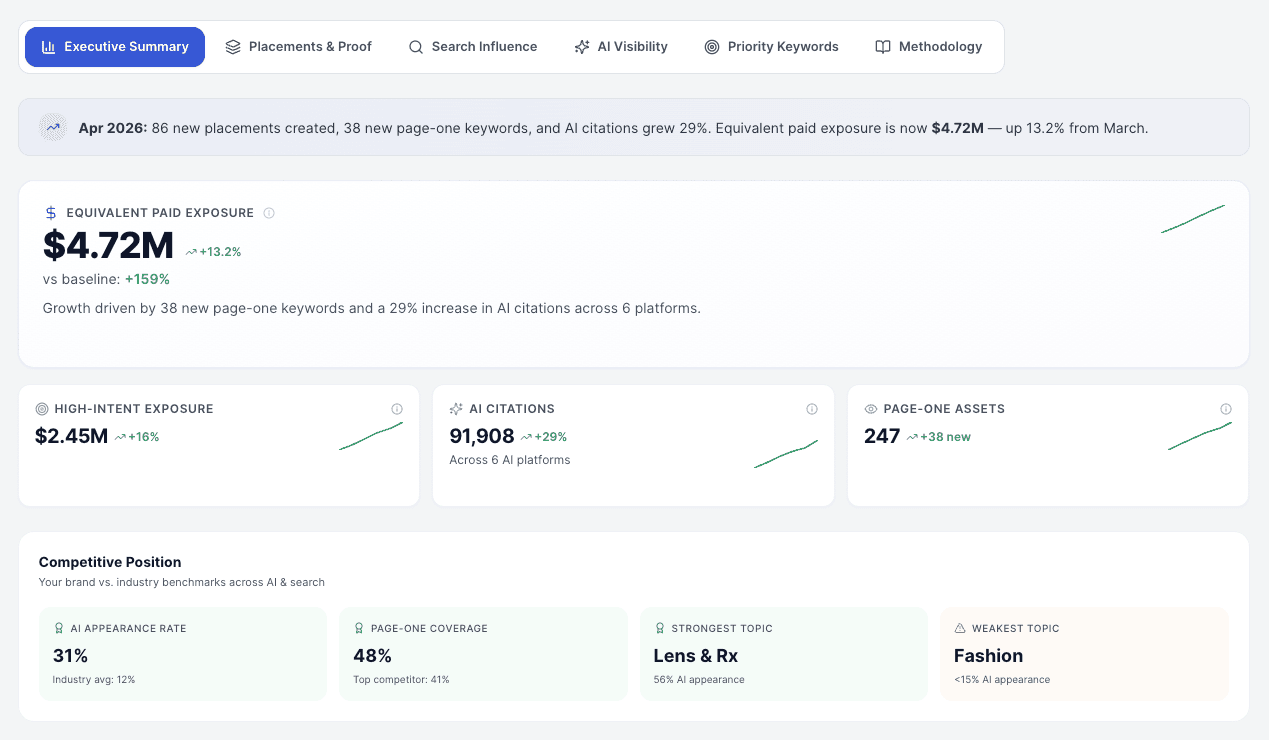
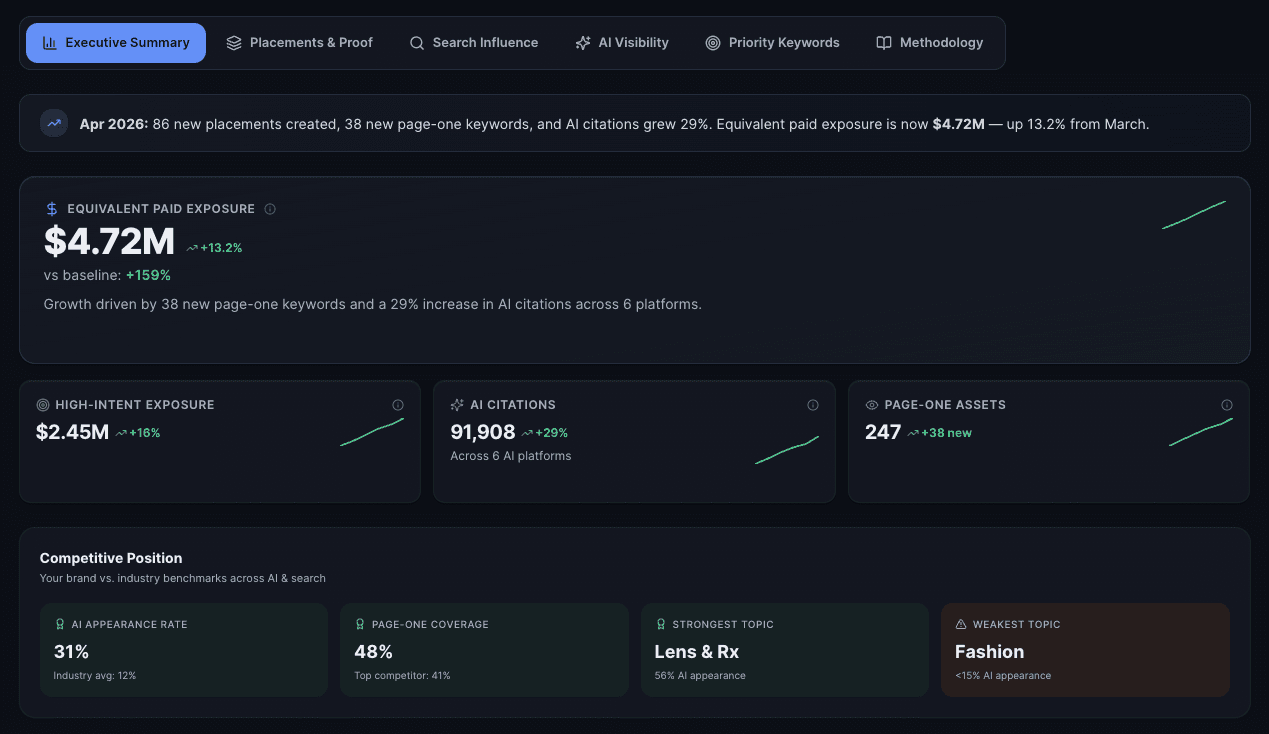
Illustrative scorecard view. Not client data, and not a fixed deliverable for every scope.
/ Reporting views
Group related buying questions so you can see whether a gap is concentrated around comparisons, fit, alternatives, pricing, or another decision area. The report states how each cluster was defined.
Compare the agreed platforms and question groups to see whether an observation appears on one platform or more widely. This is a reporting view, not a universal model ranking score.
See which companies appear on the same questions and the owned or independent URLs observed alongside the answers.
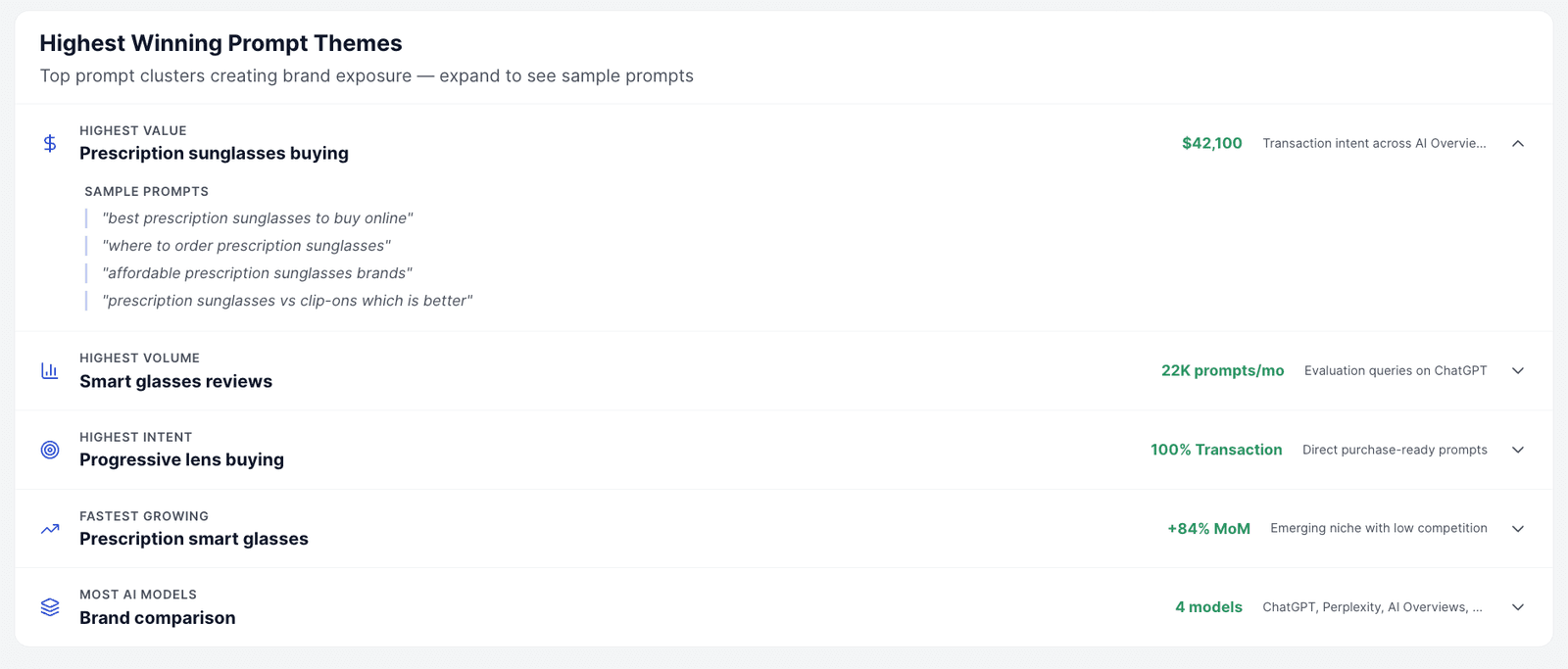
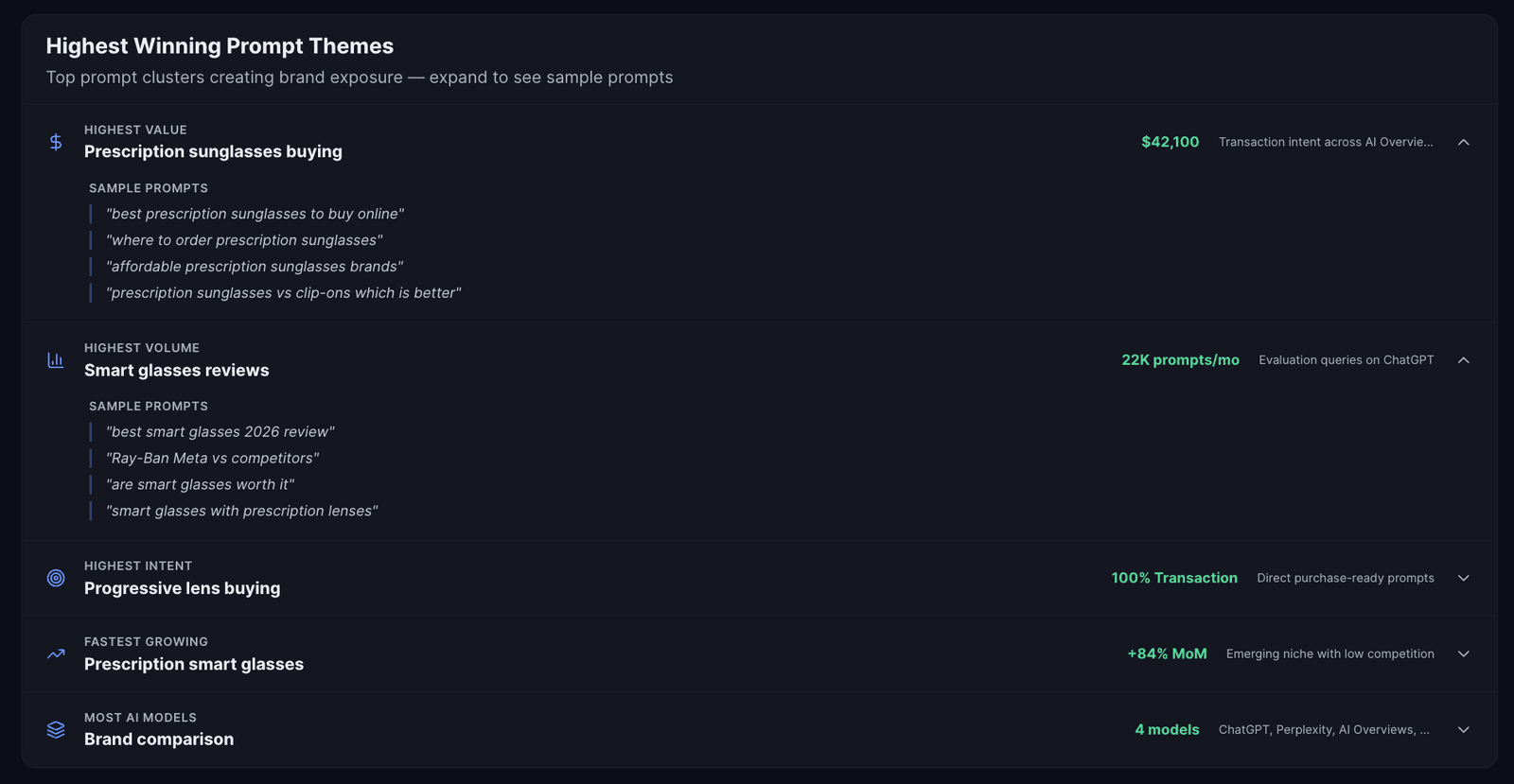
Illustrative example of a reporting view. Not client data, and not a fixed deliverable for every scope.
/ Example
Illustrative example using 20 fictional answers. No client data was collected and no AI platform was tested. The three signals can overlap.
| Signal | Count | Share of answers |
|---|---|---|
| Company named | 8 of 20 | 40% |
| Positively recommended | 5 of 20 | 25% |
| Owned page cited | 3 of 20 | 15% |
Scroll the table sideways to see every column.
/ Process
The buying questions, markets, competitors, and platforms that matter, agreed with your team first.
Answers recorded and classified against the agreed rules, with manual review where appropriate.
Exceptions and model changes noted, and repeat runs compared like for like against the same framework.
/ Why now
AI models and answer systems are still changing what they retrieve and recommend. That creates an opening: you can improve the evidence they find before incomplete or inconsistent answers become familiar to buyers. Start with a benchmark now, then measure what changes.
/ Pricing & scope
Adjust the quantities to create a planning estimate. You can use a service on its own or combine it with the full five-step system. We review every configuration before work begins.
Monthly · $100 per cluster per month · minimum 10
1 cluster = 10 related buyer-intent prompts. The controlled starting benchmark is 10 clusters / 100 prompts across 6-7 agreed LLMs.
Controlled baseline.
$1,000
Estimated first month $1,000. Estimated monthly total $1,000.
Planning estimate only. Final scope, cadence, dependencies, third-party costs, and commercial terms are confirmed in a written statement of work. AI rankings, citations, traffic, revenue, and editorial outcomes are not guaranteed.
Measurement describes a defined sample of prompts, platforms, and locations on the dates observed, and results vary between runs. Client factual approval is required before anything is published, and publishers and platforms keep editorial and ranking control.
We review the configuration for dependencies, sequencing, feasibility, and third-party costs before proposing a final scope.
/ System fit
/ FAQ
One run is a snapshot of that date and prompt set. Repeat runs show how much answers vary and whether an observation holds, but no number of runs is a complete census of every possible AI conversation.
It is a defined set of agreed questions, not a statistically representative sample of all buyer conversations. Where a broader claim would need justified sampling, we say so rather than imply it.
No. Measurement shows where you stand and what changed; improving the pages, content, and sources is implementation work, scoped separately under our GEO services.
No. AI systems are outside our control and their answers vary by model, prompt, session, location, and date. We commit to an agreed framework, careful collection, and honest reporting of what we observe.
/ Next step
Agree a measurement framework your team can use to make the next decision. Every request is reviewed manually by our team.