

Tata Harper AI Visibility Market Strategy Report - Luxury Skin Care Brands
Answer Capsule
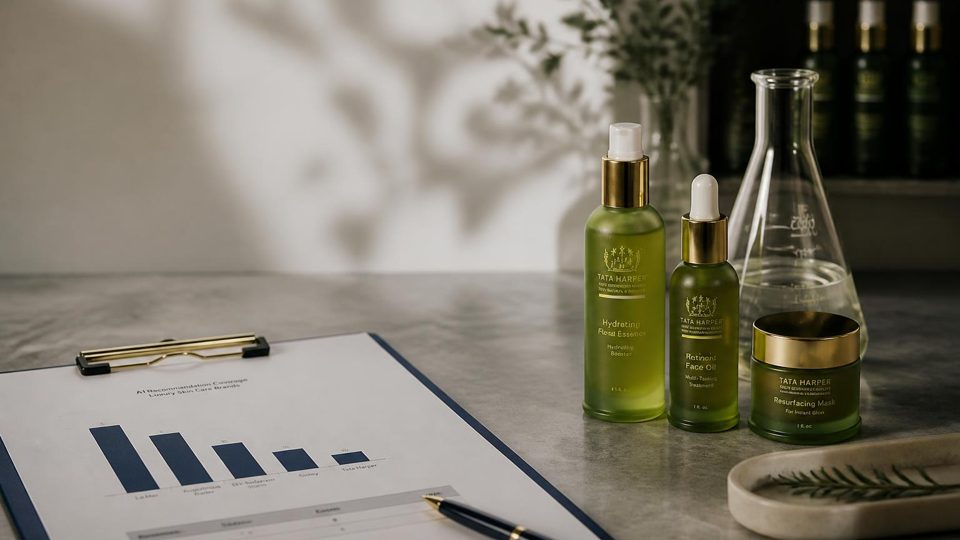
Tata Harper holds 3.25% valid recommendation coverage in the October 2026 LLM Authority Index luxury skin care benchmark, the lowest of the ten tracked brands. The brand appears in 5.24% of qualified AI responses but converts that presence into valid recommendations only 3.25% of the time, and it recorded no rank-one recommendations in the month. The clearest weakness is recommendation conversion at the shortlist stage. The clearest opportunity is a narrow but real pocket of positive framing that can be extended into top-three placement.
Who This Report Is For
This report is written for Tata Harper's brand, growth, and ecommerce leadership, and for category analysts tracking how luxury skin care brands are surfaced and recommended inside AI-generated answers.
Report Card
Field | Value |
|---|---|
Report type | AI Visibility Company Market Strategy Report |
Target company | Tata Harper |
Category / market studied | Luxury Skin Care Brands |
Reporting month | October 2026 |
AI platforms tracked | 6 (ChatGPT, Copilot, Gemini, Perplexity, Google AI Overviews, Google AI Mode) |
Public high-intent clusters | 3 (1 with qualified data) |
AI observations analyzed | 553 qualified observations |
Competitors tracked | 10 |
Executive Summary
Tata Harper is visible in AI-generated luxury skin care answers but is rarely recommended. The brand recorded 29 mentions across 553 qualified observations in October 2026, a raw mention presence rate of 5.24%, and converted those mentions into 18 valid recommendations, a valid recommendation coverage rate of 3.25%. That coverage rate is the lowest of the ten tracked brands and sits 46.9 percentage points below the category leader, Augustinus Bader, at 50.1%.
The gap between presence and recommendation is the central finding. Tata Harper appears in roughly one in nineteen qualified AI responses, but appears in a valid recommendation shortlist in only about one in thirty-one. The brand is being referenced without being chosen.
Framing quality is not the problem. Tata Harper recorded 21 positive mentions, 8 neutral mentions, and zero negative mentions in October 2026, producing a net sentiment score of 0.7241. That score is higher than La Mer (0.6915), Sisley Paris (0.6425), and Clé de Peau Beauté (0.5641). When AI systems do discuss Tata Harper, they frame it favorably. The issue is that favorable framing is not converting into shortlist inclusion.
Placement is the sharpest weakness. Tata Harper recorded 5 top-three placements in October 2026, a top-three rate of 0.90%, and zero rank-one placements, a rank-one rate of 0.00%. The brand has no first-position recommendation credit anywhere in the October 2026 dataset. Its average recommended rank of 4.29 applies only to the small set of rank-eligible recommendations it did receive.
The strongest platform signal is Copilot, where Tata Harper recorded a 12.07% valid recommendation coverage rate and a 0.8750 net sentiment score, both well above its category-wide averages. The weakest platform signal is Gemini, where the brand recorded a single valid recommendation and zero recommendation value. Google AI Overviews, the largest platform by observation volume at 161 observations, produced only 3 Tata Harper mentions and a 1.86% valid recommendation coverage rate.
The benchmark also shows a declining pattern. Tata Harper's valid recommendation coverage fell from 4.0% in August 2026 to 3.25% in October 2026, a decline of roughly 0.8 percentage points, and the brand declined in each of the two months since the baseline. The absolute counts are small, so percentage movement should be read with caution, but the direction is consistent.
What Tata Harper Is Winning
Questions This Section Answers
- Where does Tata Harper actually earn recommendation credit in AI answers?
- How strong is Tata Harper's framing quality compared with more visible competitors?
Tata Harper's clearest win is framing quality. The brand recorded zero negative mentions across 553 qualified observations in October 2026, and its net sentiment score of 0.7241 places it above several larger, more visible competitors. AI systems that mention Tata Harper describe it positively.
The second win is platform-specific. On Copilot, Tata Harper recorded a 12.07% valid recommendation coverage rate, a 0.8750 net sentiment score, and 7 valid recommendations across 58 platform observations. That coverage rate is more than triple the brand's category-wide rate of 3.25%, and it shows the brand can earn shortlist inclusion when the retrieval and synthesis conditions are right.
The third win is a narrow top-three pocket. Tata Harper recorded 5 top-three placements in October 2026, up from 3 in August 2026, and its top-three rate improved from 0.50% to 0.90%. The absolute numbers are small, but the direction is positive and the brand is not absent from top-three consideration entirely.
These are real but limited wins. Tata Harper does not hold a leading position on any platform, does not appear in any rank-one placement, and does not lead any cluster. The wins describe a brand with a credible framing story and a narrow conversion pocket, not a brand with category momentum.
Where Tata Harper Has the Clearest AI Visibility Gaps
Questions This Section Answers
- Why does Tata Harper's AI presence fail to convert into valid recommendations?
- How far behind are Tata Harper's top-three and rank-one placement rates compared with the category leaders?
- Which platforms and buyer intent clusters remain unmeasured or effectively absent for Tata Harper?
The clearest gap is recommendation conversion. Tata Harper's raw mention presence rate of 5.24% is higher than its valid recommendation coverage rate of 3.25%, meaning roughly two in five Tata Harper mentions do not convert into a valid recommendation. Across the category, the brands that lead on coverage convert presence into recommendation credit at a much higher rate. Augustinus Bader converts 67.6% presence into 50.1% coverage. SkinCeuticals converts 49.5% presence into 40.3% coverage. Tata Harper converts 5.24% presence into 3.25% coverage.
The second gap is top-three and rank-one placement. Tata Harper's top-three rate of 0.90% is the second lowest in the tracked set, ahead only of Guerlain at 0.00%. Its rank-one rate of 0.00% is tied with Guerlain for the lowest in the category. The brand is not being placed at the top of AI-generated shortlists in any qualified observation.
The third gap is platform concentration. Tata Harper's recommendation credit is heavily concentrated on Copilot and Perplexity, which together account for 11 of its 18 valid recommendations. On Google AI Overviews, the largest platform by observation volume, the brand recorded only 3 mentions and a 1.86% valid recommendation coverage rate. On Gemini, the brand recorded 1 valid recommendation and zero recommendation value. The brand is effectively absent from the two highest-volume Google surfaces.
The fourth gap is competitive displacement. SkinCeuticals, the category's strongest challenger by captured recommendation value, holds a 26.58% top-three rate and a 10.49% rank-one rate. Augustinus Bader holds a 35.62% top-three rate and a 14.29% rank-one rate. La Mer holds a 31.83% top-three rate and a 13.92% rank-one rate. When AI systems form a luxury skin care shortlist, Tata Harper is competing against brands that appear in the top three roughly thirty times more often.
The fifth gap is cluster coverage. All 553 qualified observations in October 2026 fell into the Brand Recommendation cluster. The benchmark recorded zero qualified observations in the Pricing and Value cluster and zero in the Multi-Brand Comparison cluster. Tata Harper's position in those buyer-intent classes is unmeasured, which means the brand cannot currently see how AI systems frame it on price, value, or head-to-head comparison questions.
Biggest Opportunity
Questions This Section Answers
- Which Google surfaces offer Tata Harper the clearest path from positive framing to top-three placement?
- What role do editorial and retailer source pages play in Tata Harper's recommendation gap?
Tata Harper's biggest opportunity is converting its positive framing into top-three placement on the highest-volume Google surfaces. The brand already earns favorable treatment when it is mentioned, with zero negative mentions and a net sentiment score of 0.7241. The gap is not reputation. It is retrievability and shortlist inclusion on Google AI Overviews and Google AI Mode, where the brand currently records 3 and 2 valid recommendations respectively against platform observation volumes of 161 and 107.
The path runs through the Brand Recommendation cluster, which is the only cluster with qualified data and the only place where Tata Harper can currently earn recommendation credit. Within that cluster, the brand needs to appear in the source pages that AI systems retrieve when forming luxury skin care shortlists. The benchmark's citation layer shows that AI recommendations in this vertical draw heavily on third-party editorial coverage and retailer listings, with whowhatwear.com, allure.com, instyle.com, bluemercury.com, and dermstore.com all appearing in the top ten cited domains. Tata Harper's own domain does not appear in the top ten. The opportunity is to build presence in the editorial and retailer source layer that AI systems already cite, so that the brand's existing positive framing has a retrievable evidence base behind it.
Competitive Landscape
Questions This Section Answers
- How does Tata Harper's top-three and rank-one performance compare with the leading luxury skin care brands?
- What does Tata Harper's sentiment score relative to its placement say about its position in AI shortlists?
Augustinus Bader holds the strongest recommendation-stage position in the category, with SkinCeuticals and La Mer forming a clear top three above 40% valid recommendation coverage. Tata Harper sits at the bottom of the tracked set on both top-three rate and rank-one rate, with its recommendation credit concentrated in a narrow platform pocket.
Brand | Top-3 rate | Rank-1 rate | Avg recommended rank | Sentiment |
|---|---|---|---|---|
Augustinus Bader | 35.62% | 14.29% | 2.34 | 0.8048 |
La Mer | 31.83% | 13.92% | 2.08 | 0.6915 |
SkinCeuticals | 26.58% | 10.49% | 2.47 | 0.8504 |
20.07% | 6.15% | 2.60 | 0.7303 | |
Clé de Peau Beauté | 5.97% | 1.81% | 3.49 | 0.5641 |
5.61% | 1.08% | 4.10 | 0.7851 | |
Guerlain | 4.52% | 0.54% | 3.53 | 0.6275 |
Dr. Barbara Sturm | 3.80% | 0.18% | 4.19 | 0.6596 |
Sisley Paris | 2.71% | 0.54% | 4.35 | 0.6425 |
Tata Harper | 0.90% | 0.00% | 4.29 | 0.7241 |
Average recommended rank covers rank-eligible recommendations only.
Tata Harper's row shows the clearest version of the visibility-without-recommendation pattern in the category. Its sentiment score of 0.7241 is higher than five brands ranked above it, including La Mer and Sisley Paris, but its top-three rate of 0.90% is the second lowest in the set and its rank-one rate of 0.00% is tied for last. The brand is framed well and placed poorly.
Prompt Evidence
Copilot / Brand Recommendation Prompt: "What are the top 10 best skincare brands?" Result: Tata Harper recorded 7 valid recommendations on Copilot with a 12.07% coverage rate and a 0.8750 net sentiment score, its strongest platform-level conversion in the dataset.
Google AI Overviews / Brand Recommendation Prompt: "What are the top skincare brands?" Result: Tata Harper recorded only 3 mentions across 161 Google AI Overviews observations, with a 1.86% valid recommendation coverage rate and zero top-three placements.
Gemini / Brand Recommendation Prompt: "What is the best skin care line for aging skin?" Result: Tata Harper recorded 1 valid recommendation on Gemini with zero recommendation value and a 1.45% valid recommendation coverage rate, the weakest platform result in the dataset.
Perplexity / Brand Recommendation Prompt: "What is the best face mask for rosacea?" Result: Tata Harper recorded 4 valid recommendations on Perplexity with a 4.94% coverage rate and a 0.6667 net sentiment score, showing a second platform where the brand earns modest shortlist credit.
What CiteWorks Studio Would Do Next
Phase 1: AI Market Discovery Audit Map exactly which luxury skin care prompts surface Tata Harper, which competitors appear alongside it, and which source pages AI systems retrieve when forming those answers.
Phase 2: Recommendation Readiness Plan Prioritize the Google AI Overviews and Google AI Mode gaps, where Tata Harper's observation volume is highest and its recommendation credit is lowest.
Phase 3: Owned Answer Layer Buildout Strengthen the brand's own product, ingredient, and comparison pages so they answer the specific luxury skin care questions AI systems are already asking.
Phase 4: Citation and Authority Layer Development Build presence in the editorial and retailer domains the benchmark shows AI systems cite most often, including beauty editorial and prestige retail listings.
Phase 5: Monthly AI Visibility and Recommendation Tracking Track top-three rate, rank-one rate, and platform-level coverage month over month to confirm whether the conversion gap is closing.
Why This Matters
Tata Harper's problem is not reputation. The brand records zero negative mentions and a net sentiment score of 0.7241, higher than several brands that appear in AI shortlists far more often. The problem is that positive framing without retrievable evidence does not produce recommendation credit. When a buyer asks an AI system which luxury skin care brand to choose, Tata Harper is described favorably but is not placed in the top three, and it is never placed first.
AI presence alone is not enough. The next move is targeted correction of the prompt, page, and citation layers so that the brand's existing positive framing has a retrievable source base behind it. That means answering the specific high-intent questions AI systems are already asking, strengthening the owned pages that support those answers, and building presence in the third-party editorial and retailer domains that the benchmark shows AI systems rely on in this category.
Core Metrics
Metric | Value |
|---|---|
Mentions | 29 |
Valid recommendations | 18 |
Top 3 recommendation count | 5 |
Rank #1 recommendation count | 0 |
Average recommended rank | 4.29 |
Positive mentions | 21 |
Neutral mentions | 8 |
Negative mentions | 0 |
Raw mention presence rate | 5.24% |
Valid recommendation coverage | 3.25% |
Top 3 recommendation rate | 0.90% |
Rank #1 recommendation rate | 0.00% |
Net sentiment score | 0.7241 |
Strongest cluster by recommendation behavior | Best Luxury Skin Care Brands and Products (C01) |
Strongest platform by recommendation behavior | Copilot |
Sentiment Score
Questions This Section Answers
- Why is counting all AI mentions as wins misleading for a luxury skin care brand?
- What does Tata Harper's net sentiment score reveal about the difference between perception and placement?
Sentiment Score = (positive mentions × 1 + neutral mentions × 0 + negative mentions × -1) / total mentions
For Tata Harper in October 2026: (21 × 1 + 8 × 0 + 0 × -1) / 29 = 0.7241.
This matters because unclassified mention counts are misleading. A brand can appear frequently in AI responses and still be described cautiously, neutrally, or as a comparison anchor rather than as a recommendation. Counting all mentions as wins is bad measurement. Share of voice is a diagnostic metric, not a business KPI. A positive recommendation, a neutral reference, a cautionary mention, and a competitor-displaced mention are not equal, and treating them as equal hides the difference between being discussed and being chosen.
Tata Harper's score of 0.7241 tells a specific story. When AI systems mention the brand, they frame it positively. That is a real asset. But framing quality is not the same as recommendation conversion, and Tata Harper's 3.25% valid recommendation coverage shows that positive framing is not currently translating into shortlist inclusion. Classified sentiment is required before interpreting AI visibility, and in Tata Harper's case it clarifies that the gap is placement, not perception.
Sentiment by Platform
Questions This Section Answers
- On which platforms does Tata Harper receive its strongest positive framing?
- Which platform sentiment signals are based on samples too small to draw conclusions from?
Platform | Mentions | Positive | Neutral | Negative | Sentiment Score | Readout |
|---|---|---|---|---|---|---|
Copilot | 8 | 7 | 1 | 0 | 0.8750 | Strongest public recommendation signal |
Perplexity | 6 | 4 | 2 | 0 | 0.6667 | Present, but not recommendation-led |
ChatGPT | 5 | 4 | 1 | 0 | 0.8000 | Positive, but sample too small |
Google AI Overviews | 3 | 3 | 0 | 0 | 1.0000 | Positive, but sample too small |
Google AI Mode | 4 | 2 | 2 | 0 | 0.5000 | Present as context, not recommendation |
Gemini | 3 | 1 | 2 | 0 | 0.3333 | Present, but not recommendation-led |
Methodology
- This report is a benchmark-based analysis of Tata Harper's AI visibility and recommendation position in the luxury skin care category for October 2026. It is not a client implementation result.
- The reporting window is October 2026, with comparisons to the August 2026 baseline and September 2026 where the benchmark provides them.
- Six AI surface families were tracked: ChatGPT, Copilot, Gemini, Perplexity, Google AI Overviews, and Google AI Mode. All six recorded qualified observations in October 2026.
- The October 2026 benchmark began with 800 prompt-surface observations and produced 553 qualified observations after relevance and qualification filtering. Brand-level rates use the 553 qualified observations as the denominator.
- Ten brands were tracked in the luxury skin care category: Augustinus Bader, La Mer, SkinCeuticals, La Prairie, Sisley Paris, SK-II, Clé de Peau Beauté, Guerlain, Dr. Barbara Sturm, and Tata Harper. The October 2026 data presents the Guerlain entry in mixed casing, which reflects a naming variant in the dataset rather than two distinct commercial entities. The brand is referred to as Guerlain throughout this report.
- Three public high-intent clusters were defined: Best Luxury Skin Care Brands and Products (consideration), Luxury Skin Care Brand Comparisons (evaluation), and Luxury Skin Care Pricing and Value (decision). Only the Brand Recommendation cluster recorded qualified observations in October 2026.
- Stage 0 extraction produced the prompt-level observations that retain the query, AI surface, answer, brand outcome, recommendation placement, sentiment, and, where exposed, citations or attributable evidence sources.
- A mention is counted when a tracked brand appears anywhere in a qualified AI response, regardless of whether it is recommended. Raw mention presence rate is the share of qualified observations where the brand is mentioned at all.
- A valid recommendation is counted when a brand appears in a valid recommendation shortlist within a qualified response. Valid recommendation coverage is the share of qualified observations where the brand appears in such a shortlist. Negative, neutral, cautionary, comparison-anchor, and listed-only mentions are not counted as valid recommendations.
- Top-three rate is the share of qualified observations where the brand appears among the top three recommendations. Rank-one rate is the share of qualified observations where the brand is the first recommendation. Average recommended rank covers rank-eligible recommendations only.
- The unique question count for October 2026 was 588 after deduplication. The benchmark does not publish a unique prompt count for the public version.
- Limitations: all 553 qualified observations fell into a single buyer-intent cluster, so the benchmark cannot currently answer how AI systems position Tata Harper on price, value, or direct brand comparison. Tata Harper's absolute counts are small, with 29 mentions and 18 valid recommendations, so percentage movements should be read with caution. Source presence in the citation layer is evidence about the information environment and is not automatically proof that a source caused a recommendation.
See How AI Is Recommending Your Brand
The public benchmark shows where Tata Harper stands in AI-generated luxury skin care recommendations. A company-level AI visibility audit maps the specific prompts, platforms, competitors, and source pages shaping those answers, and turns the benchmark's signals into a prioritized plan for closing the recommendation gap.